
Chronic Sciatica
On This Page
Sciatica affects up to 40% of people at some point in their lifetime. 90% of cases are caused by a herniated disc and resolve naturally within 6-12 weeks. However, 10% of patients require surgical intervention. Sciatica is a major cause of work disability.
Symptoms and Causes of Sciatica
Symptoms
The symptoms of sciatica usually affect your bottom and the back of one leg, often including your foot and toes. Symptoms include:
- A sharp, burning pain down the back of the leg which extends to the toes
- Tingling – like pins and needles
- Numbness
- Weakness
Symptoms may come on suddenly but they can also start slowly.
The pain may be worse when moving, sneezing or coughing. You may also experience back pain, but it’s not usually as bad as the pain in your leg.
Causes of Sciatica
Sciatica occurs when something presses or rubs on the sciatic nerve, such as:
- A herniated disc (also known as slipped disc or prolapsed disc) – when the soft cushion of tissue (nucleus pulposus) in discs between the vertebrae in your spine pushes out due to degenerative disc disease, causing the disc to move from its natural position, allowing it to put pressure on the sciatic nerve. This is the most common cause of sciatica and is more likely to happen as you get older. For more information, see our degenerative disc disease overview (PDF)
- Spinal stenosis – narrowing of the part of your spine where nerves pass through
- Spondylolisthesis – when one of the bones in your spine slips out of position
- A back injury
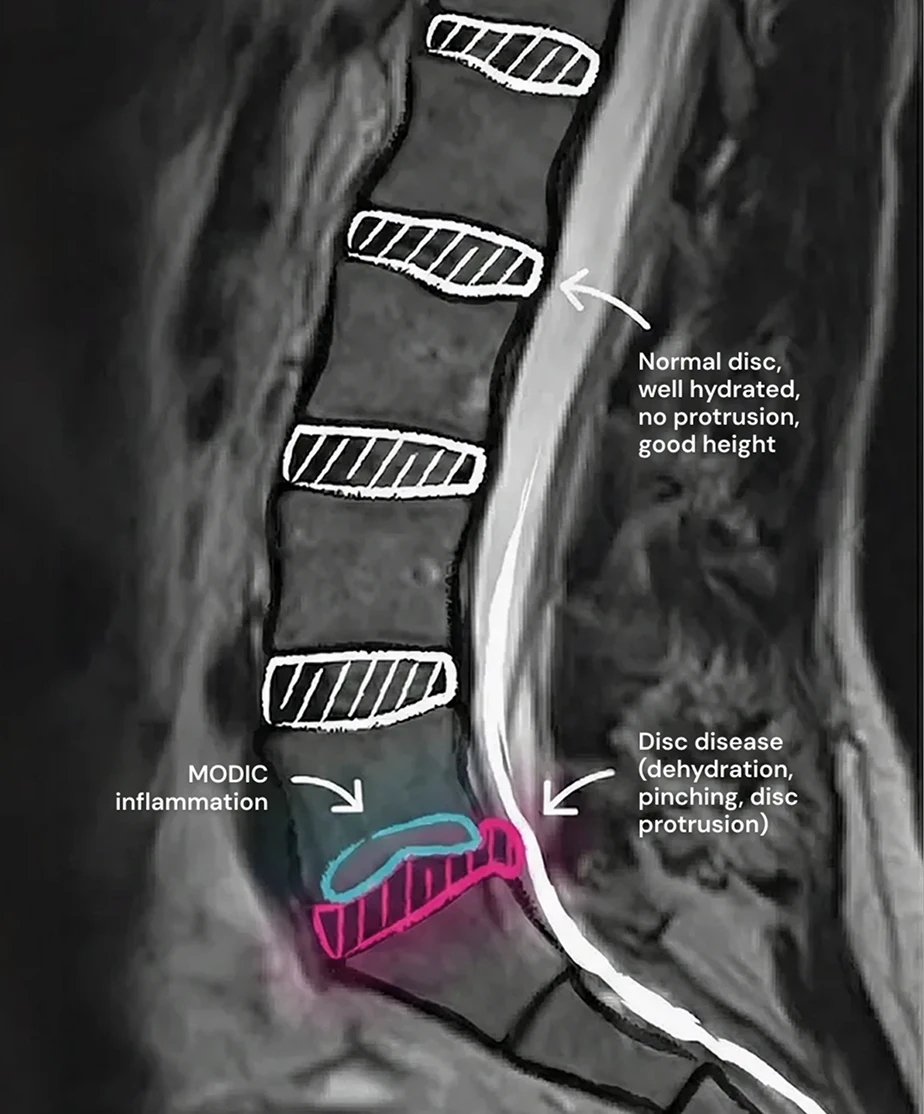
Why Are You in Pain?
- Degenerated disc fragments compress the sciatic nerve
- Degeneration of a lumbar disc, due to multiple factors (genetic, postural, traumatic, overload, etc.)
- Disc pinching, with dehydrated, bulging (protrusion) and sometimes inflammatory (modic) changes of the disc
Does Sciatica Heal Naturally?
Mild cases often resolve on their own. However, once repeat symptoms become chronic, they normally continue to deteriorate until surgical intervention is required.
What Treatments are Available?
Treatments for herniated discs vary depending on the severity of the symptoms.
For mild cases, painkillers, physiotherapy and walking will help to resolve symptoms naturally.
If frequency and severity of symptoms increase, surgical intervention is often required.
Typical options available to patients are:
- Steroid injections provide temporary relief of symptoms by decreasing inflammation around the site of herniated discs which are the cause of sciatica.
- Discectomy to relieve symptoms by removing disc fragments pressing on the sciatic nerve.
Discectomies often provide temporary symptom relief as further disc degeneration occurs allowing additional disc fragments to press on spinal nerves. - Spinal fusion which permanently fuses vertebrae together using titanium rods and screws allowing the degenerated disc to be removed.
- Prodisc® L total lumbar disc replacement which replaces the degenerated natural disc with an artificial disc to restore spinal mobility and permanently relieve symptoms.
How Does SpinePro Treat Sciatica?
SpinePro, in conjunction with CCV Montpellier, offers Prodisc® L total lumbar disc replacement, a minimally invasive surgical procedure which fully restores spinal mobility and permanently relieves symptoms in a single procedure by safely replacing the degenerated natural disc with an artificial disc.
If you have a lumbar MRI scan less than 6 months old, contact SpinePro for your free surgical assessment to see if you are a candidate for total lumbar disc replacement.