
Diagnosis of Degenerative Disc Disease
On This Page
If you’re experiencing persistent lower back pain and/or acute sciatica that does not respond to medication or physical therapy, you may be wondering whether a slipped or herniated disc due to degenerative disc disease could be the cause.
Degenerative disc disease describes the deterioration of one or more intervertebral discs – the cushioning, bearing-like structures between the bones of the spine. When intervertebral discs dehydrate, allowing the soft gel-like nucleus pulposus to leak out, the disc can move from its natural position, causing inflammation that presents as lumbar back pain. Disc fragments may also compress spinal nerves presenting as acute sciatica.
What Scans Are Needed?
A definitive diagnosis of degenerative disc disease requires lumbar MRI and CT scans – the MRI scan shows the condition of soft tissue whereas the CT scan shows the condition of spinal vertebrae.
MRI uses magnetic fields rather than radiation to create detailed images of soft tissues. This makes it particularly suited to visualising discs. On MRI, a healthy disc appears bright on certain image sequences, reflecting its water content. Degenerated discs lose this appearance as they are dehydrated. The scan can also show whether a disc has herniated (moved) and is pressing on nerve roots.
Referencing both scans, we can assess the condition of the disc, the extent to which the disc has herniated (moved), inflammation around the affected disc, and whether disc fragments are compressing spinal nerves or roots.
A clinical assessment alone cannot determine whether symptoms of an acute herniated (slipped) disc are being caused by degenerative disc disease.
Getting a Diagnosis of Degenerative Disc Disease
Patients usually see their GP or regular doctor when lumbar pack pain and/or sciatica become persistent and can no longer be managed by over-the-counter medication and physical therapy.
Your doctor may prescribe stronger medication for a few weeks to see if symptoms resolve on their own. If symptoms persist or get worse, you may be referred for an MRI scan. However, waiting times for imaging through public health services such as the NHS can be lengthy, so many patients elect to have their scans privately.
After your scan, your GP or regular doctor will discuss the radiologist’s findings with you. Common diagnoses given as the cause of persistent lumbar back pain and sciatica include slipped or herniated discs. However, it should be noted that these terms describe the same condition, both resulting from degenerative disc disease.
Your doctor may discuss treatment options with you or refer you to a specialist. However, surgical options in the UK, as in many other countries, are limited.
Have an MRI scan?
If you have a lumbar MRI scan less than 6 months old, contact SpinePro for your E-Diagnosis to see if you are a candidate for Prodisc® L total lumbar disc replacement.
How Does SpinePro Treat Herniated Discs?
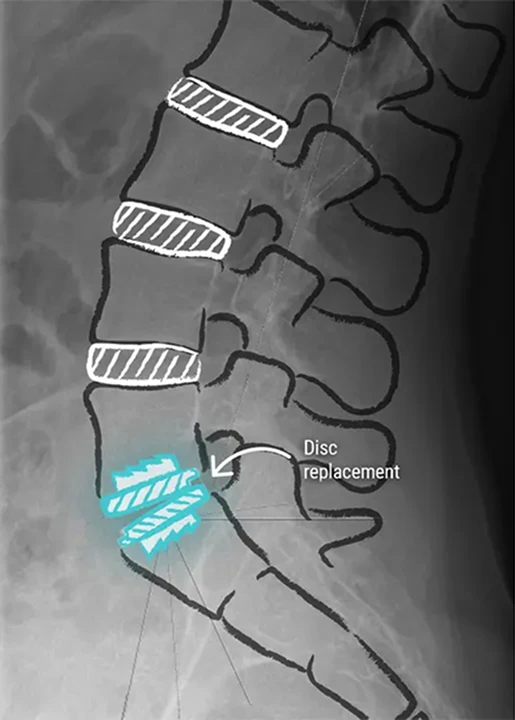
SpinePro offers Prodisc® L total lumbar disc replacement, a minimally invasive surgical procedure designed to restore spinal mobility and provide lasting symptom relief by replacing the degenerated natural disc with an artificial disc.
Frequently Asked Questions
What's the difference between an MRI and a CT scan for spine problems?
MRI uses magnetic fields to create detailed images of soft tissues, making it ideal for assessing the condition of intervertebral discs. CT scans use X-rays and show bone structure more clearly. An accurate diagnosis of degenerative disc disease usually requires both types of scans.
Do I need a referral for a spine MRI?
Public health services such as the NHS typically require a referral for an MRI scan. Your doctor will assess whether imaging is appropriate based on your symptoms and how long you’ve had them. If you have private health insurance or are paying directly, you can often arrange a scan without a referral by booking with a private imaging centre or consultant.
What should I expect during a lumbar spine MRI?
You’ll lie on a padded table that slides into the scanner. The scan takes 20 to 40 minutes, during which you’ll need to stay still. The machine makes knocking and buzzing sounds; you’ll usually be given headphones or earplugs. The scan itself does not cause pain. If you’re claustrophobic, tell the radiography team beforehand, as they can offer reassurance or, in some cases, use an open scanner.
Does disc degeneration always show on MRI?
MRI is highly sensitive for detecting disc degeneration, and significant changes are rarely missed. Degenerated discs appear darker due to loss of water content. However, early or mild degeneration may be subtle.